An eight month old rolled off a hotel bed in San Francisco and bumped his head. At the emergency room he was checked, he drank a bottle of formula, and he fell asleep in his mother’s arms.
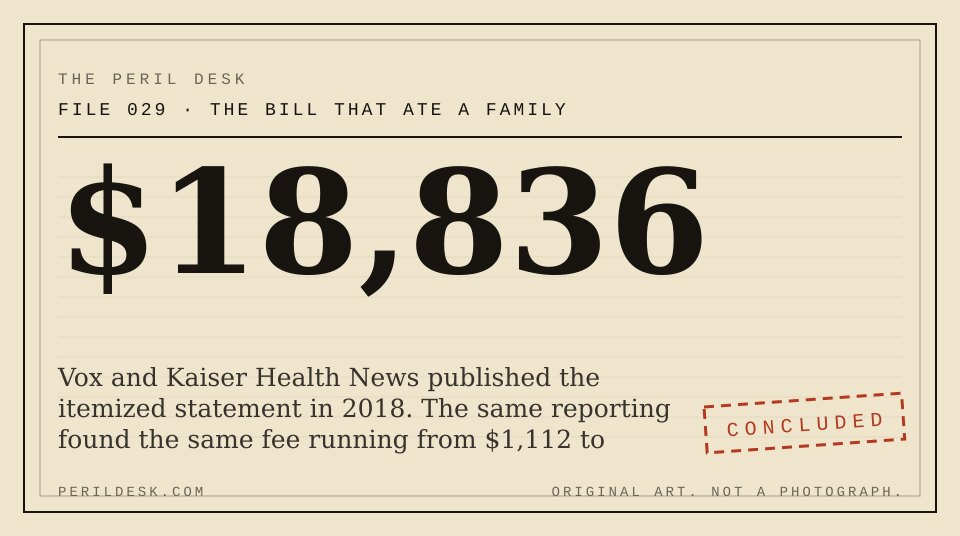
The bill came to $18,836. One line on it was $15,666.
That line was not for a scan, a stitch or a drug. Reporters at Vox and Kaiser Health News published the itemized statement, and the line had a name: trauma activation.
Three hours and twenty two minutes
The child was Park Jeong Whan. His family was visiting from South Korea in 2016 when he fell off the bed in their hotel room onto a carpeted floor.
His parents called 911, and an ambulance took the family to Zuckerberg San Francisco General Hospital, the city’s public hospital.
He never lost consciousness. Staff examined him, found nothing broken and nothing bleeding inside, and cleared him.
His mother put a bandage on him herself. He napped. He drank formula. The family left.
The visit lasted three hours and twenty two minutes, start to finish.
The reporting project that made the bill public
Jenny Gold and Sarah Kliff reported the case for Vox and Kaiser Health News, in a project that gathered emergency room bills from readers across the country and read them line by line.
That is where the number came from. Not a press release, not a lawsuit, but the family’s own itemized statement, published with the family’s cooperation.
Without the itemized statement, the $15,666 would be a rumor with a dollar sign on it.
The family carried travel insurance. It paid $5,000, which is what the policy was written to pay.
That left $13,836 sitting on a family that had been in the country as tourists, and it sat there until the story ran.
The line that was not a treatment
A trauma activation fee is, in plain terms, a charge for switching on a trauma team.
Trauma centers keep surgeons, nurses and equipment on standby. When an ambulance or a paramedic radios ahead with a report suggesting a patient may need life saving care, the hospital “activates,” meaning it pulls that team into place before the patient arrives.
The fee is billed for the activation itself. It is not billed for what the team ends up doing, because sometimes the team ends up doing nothing.
Jeong Whan needed no surgeon. He needed a nap. The activation, not the treatment, is what the hospital billed, and the line for it was $15,666.
Subtract the activation line and everything else in that three hour visit comes to $3,170 of the $18,836 total.
The hospital defended it, then waived it
Zuckerberg San Francisco General defended the charge when Vox asked.
Brent Andrew, a hospital spokesman, said trauma activation applies when incoming patients are expected to need life saving services, that the hospital’s fee is low compared with other trauma centers, and that the money supports staffing and regulatory requirements placed on trauma centers. The city deals with car accidents, mass shootings and multiple vehicle collisions, he said, and “It’s expensive to prepare for that.”
The hospital also said it welcomes conversations with patients about billing problems.
Both statements can be true at the same time. A standby trauma team is genuinely expensive to keep sitting there. And an eight month old who drank formula and went home was billed for it.
After the story was published, the hospital waived the $15,666 fee. In a letter, the hospital’s patient experience manager said the hospital had done a clinical review and offered the family “a sincere apology,” Kaiser Health News reported in an editor’s note. The case, the manager wrote, “offered us an opportunity to review our system and consider changes.”
$1,112 in Missouri. $50,659 in California.
The single bill is a story. The pattern behind it is the reason the story kept moving.
Vox and Kaiser Health News, drawing on data from Medliminal, a company that tracks billing errors, found trauma activation fees ranging from $1,112 at a hospital in Missouri to $50,659 at a hospital in California.
That is a spread of more than forty five times, for a charge that describes the same act at every hospital in the country: making a phone call and gathering a team.
No public price list forced any of those numbers. Nothing in the charge’s definition sets a ceiling.
The fee also does not appear anywhere a patient could see it before the ambulance doors open. It is generated by the hospital’s decision, made minutes before arrival, based on a description of the patient given by someone else.
A nap, a bottle of formula, and $18,836
Big bills usually come attached to big events. A helicopter. A cardiac catheterization. Weeks in intensive care.
Those are hard to argue about, because something enormous plainly happened.
This bill was different. Nothing enormous happened. A baby bumped his head and slept it off, and the paper still ran to $18,836.
That is what made it useful as evidence. It isolated the charge. When the treatment is a bottle of formula, there is nowhere for a $15,666 line to hide.
The bill also landed on a family with no easy way to argue about it. They were tourists, three hours in a hospital, then a plane home, then a number, and the number moved only after a newsroom printed it.
The itemized statement carries its own arithmetic. Three hours and twenty two minutes, one bottle of formula, and a line reading trauma activation, $15,666.