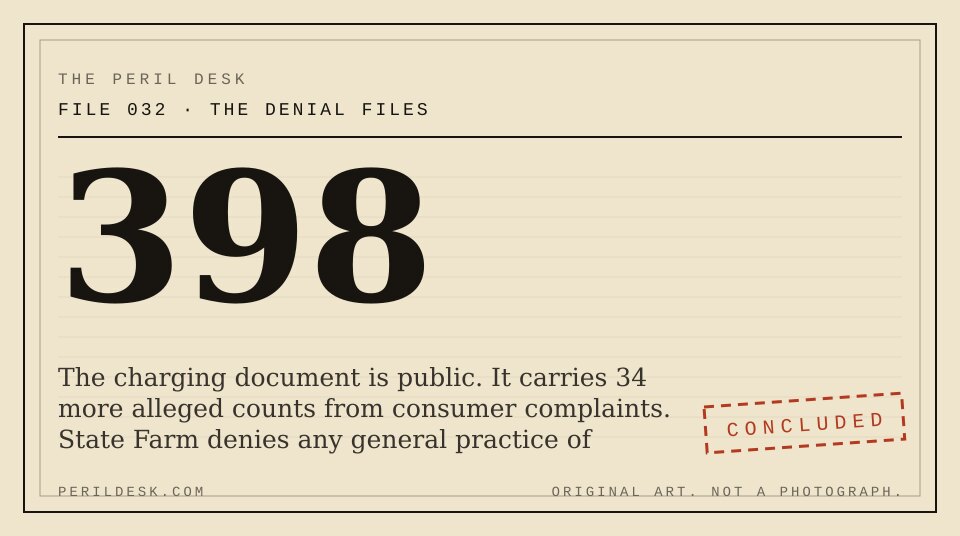
California’s insurance regulator put a number on paper, and the number is 398.
That is how many separate violations of state claims law the California Department of Insurance says it found inside 220 State Farm wildfire claim files. Every one of the 398 is an allegation. State Farm rejects them.
The number is not a rumor and it is not a leak. It sits inside a charging document the Department published itself on May 4, 2026.
The document that carries the count
The filing is called an Accusation and Order to Show Cause. That is a formal charge that starts an administrative hearing, the insurance version of a case being opened rather than closed.
It names State Farm General Insurance Company, the subsidiary that writes California home policies.
The allegations grow out of an expedited Market Conduct Examination, which is a regulator’s audit of how a company actually handled real claim files rather than what its manuals say it does.
Examiners pulled 220 residential claims tied to the January 2025 Palisades and Eaton fires in Los Angeles County. They reported violations in 114 of those 220 files.
Then they counted the violations one by one and reached 398.
The word “expedited” in front of “Market Conduct Examination” is doing something specific.
An expedited exam is a regulator deciding it will not wait for a review of the whole book. It narrows the scope, pulls a set of files, and moves.
That choice explains the shape of everything downstream. A set of 220 files is what a regulator looks at when it wants an answer in months. It is also the exact feature the company being examined will point at.
The three clocks, and the count they add up to
Most of the alleged violations are about time, and California’s claims law runs on three clocks.
The first is 15 days: the window to begin investigating a claim once it is reported.
The second is 40 days: the window to accept or deny the claim after receiving proof of loss.
The third is 30 days: the window to pay a claim once it has been accepted, or to send written notice explaining why more time is needed.
The Department alleges State Farm missed all three, repeatedly, across the files examined. Those alleged misses are what the 398 counts are mostly made of.
Clocks sound like the least interesting kind of violation, and after a total-loss fire they are close to the most important one.
A family whose house burned is paying for somewhere to sleep while they wait. Every week the acceptance decision does not arrive is a week that family funds its own displacement.
Insurance Commissioner Ricardo Lara said in the Department’s release that the investigation found the company “delayed, underpaid, and buried policyholders in red tape at the worst moment of their lives.”
Where 398 becomes 432
The examination is not the only source feeding the case.
The Department added 34 more alleged violations drawn from individual consumer complaints, separate from the 220 audited files. Added to the 398, the filing carries 432 alleged counts in total.
That total is what sets the money at risk. California can seek up to $5,000 for each violation, and up to $10,000 for each violation found to be willful.
Multiply it out and the exposure has a floor and a ceiling. At $5,000 across all 432 counts, $2,160,000. At $10,000 across all 432, $4,320,000.
Those are the statutory maximums, not a bill anyone has sent.
The arithmetic hiding inside the headline number
The 398 alleged violations did not come from 398 different families. They came from 114 files.
Divide 398 by 114 and the average flagged file carries about 3.5 alleged violations. One late claim can generate a missed 15-day clock, a missed 40-day clock, and a missed 30-day clock, and that is three counts from a single household.
So 398 is a count of alleged legal breaches, not a count of wronged policyholders. And 114 of 220 files means a bit over half the files examined were flagged for something.
Whether “something” means a paperwork slip or a family left unpaid is exactly the dispute.
State Farm’s answer, in its own words
The company has not conceded a single count.
State Farm said publicly that it rejects any suggestion it engaged in a general practice of mishandling or intentionally underpaying wildfire claims, and that it will respond through the process.
The company said the review covered 220 files and that most of the issues were administrative or procedural, involving the timing of notices, documentation, or payee details, rather than failures to pay covered claims.
It put its own arithmetic against the Department’s. State Farm said the examination identified about $40,000 in additional payments owed, against more than $5.7 billion it says it has already paid on these fires.
State Farm also called the state’s move a “reckless, politically motivated attack” and accused the Department of “turning regulatory oversight into a political weapon.”
Both sets of numbers are on the record. Neither has been tested by a judge.
Nothing here has been adjudicated. An Accusation is the first rung, not the last.
The next step is an administrative hearing where the Department has to prove the counts and State Farm gets to answer them. A count that survives that hearing means something. A count that does not survive means nothing at all.
Why 220 files is the whole story
State Farm policyholders filed roughly 11,300 residential claims after the Palisades and Eaton fires. Across all insurers, the figure was 38,835, so State Farm carried about 29 percent of the total, by our arithmetic.
The examination looked at 220 of those 11,300. That is under two percent, by our arithmetic.
The Department’s position is that a pattern found in 220 files points at the whole book. State Farm’s position is that 220 files of paperwork timing do not describe 11,300 outcomes.
That gap, between what 220 files prove and what they suggest, is the argument. The 398 is only the opening number in it.
Where the filing sits
The Department’s release is public at insurance.ca.gov, and the Order to Show Cause carrying the examination is linked from it.