A hail storm hit a Minnesota townhome complex in October 2011. On eleven of the twenty buildings it dented three siding panels or fewer, and on one building it dented exactly one.
Of the twenty, the building hit hardest lost ten panels.
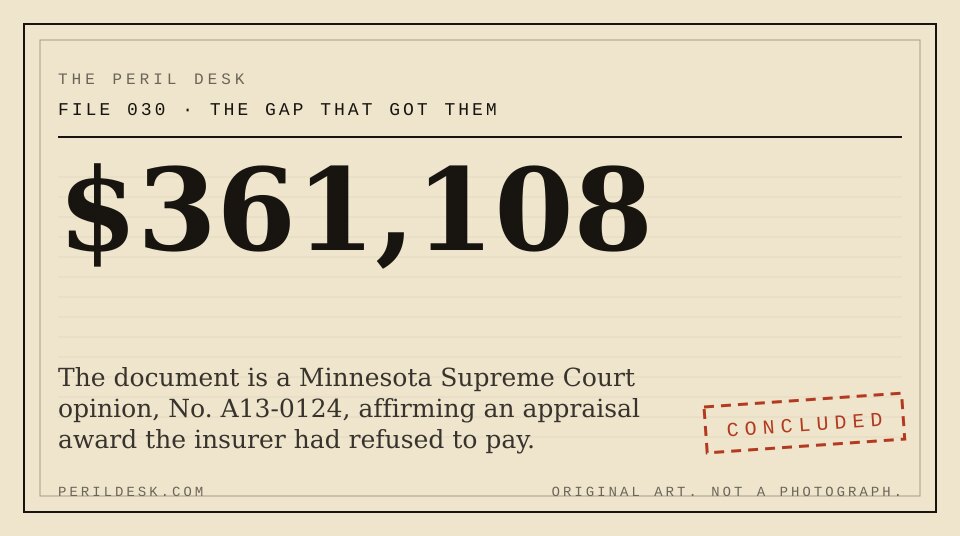
Three years later the Minnesota Supreme Court affirmed an award of $361,108, enough to re-side every building in the complex. The reason was five words that had been printed in the policy the whole time.
Twenty buildings and a handful of dents
The complex was Cedar Bluff Townhome Condominium Association, insured by American Family Mutual Insurance.
The siding was about eleven years old, and eleven years of Minnesota sun had faded it, evenly, across every wall. That is the fact the whole case sits on, and nobody disputed it.
New panels were still available from the same manufacturer, in the same product line. They just came out of the factory the original color, which was no longer the color of anything on those twenty buildings.
Replace three dented panels on a faded wall and the wall now has three panels that do not match. Not a shade off. Visibly newer.
Appraisal is the process that sets the number
The insurer and the association agreed there was damage and disagreed about how much money it took to fix it. This policy sent that dispute to appraisal.
Appraisal means each side names an appraiser, the two pick an umpire, and that panel sets the amount of the loss.
The Cedar Bluff panel looked at faded siding that could not be matched and priced the job as a full replacement of the siding on all twenty buildings.
The award came to $361,108.
American Family declined to pay it.
The five words
The policy promised, in the event of a covered loss, to replace damaged property with other property “of comparable material and quality.”
Five words. Almost nobody reads them until the estimate arrives.
The dispute was whether color lives inside those five words.
American Family’s position was that it did not. Its argument was that the policy covered the panels that were actually damaged, that nothing in the contract promised a color match, and that the appraisal panel had gone past setting an amount and had decided a coverage question it had no authority to decide.
The association’s position was that a wall with three brand new panels on it has not been replaced with anything comparable.
December 17, 2014
The Minnesota Supreme Court, in an opinion by Justice Page, affirmed the award. No justice dissented. Justice Stras took no part.
The court held that a reasonable color match is part of what “comparable material and quality” requires. Not an identical match, but a reasonable one.
Where a reasonable match cannot be achieved by swapping in individual panels, the comparable quality promise is not satisfied by swapping in individual panels.
So the appraisal panel had not invented coverage. It had priced the repair the policy already described.
Three or fewer dented panels on eleven buildings became new siding on twenty buildings, and the bridge between those two sentences was five words the insurer had written itself.
Why the ruling reaches past siding
Color match sounds like a decorating argument. It is actually an argument about what “repair” means when a building has aged.
Every material on a building fades, weathers or is discontinued, and that goes for roof shingles, brick, vinyl, countertops and wood floors alike.
A policy that pays to replace the damaged piece, and only the damaged piece, quietly assumes the undamaged pieces still look like new. On an eleven-year-old building that assumption is false on every wall.
Cedar Bluff is the case that says the assumption does not override the contract language. What the opinion settles is Minnesota, and it settles it on the policy’s own words.
The narrower lesson is about who decides. American Family argued the appraisal panel had exceeded its role. The court disagreed on these facts, and the number the panel wrote stood.
An appraisal award is not a suggestion. It took a state supreme court to say so out loud, and it took three years.
The docket number is A13-0124 and the full opinion is linked in the Sources block below.