In the winter of 1933, a group of men in the Bronx held life insurance on a man who did not know he was worth anything to anyone.
His name was Michael Malloy. He was Irish-born, about 60, and homeless. The men who held his policies expected the drink to finish him.
He outlasted every plan they had, for weeks. The press ended up naming the group after its structure, the Murder Trust, and naming Malloy after his one consistent quality. They called him Mike the Durable.
The arithmetic that started it
The plan began with a small number and a large idea.
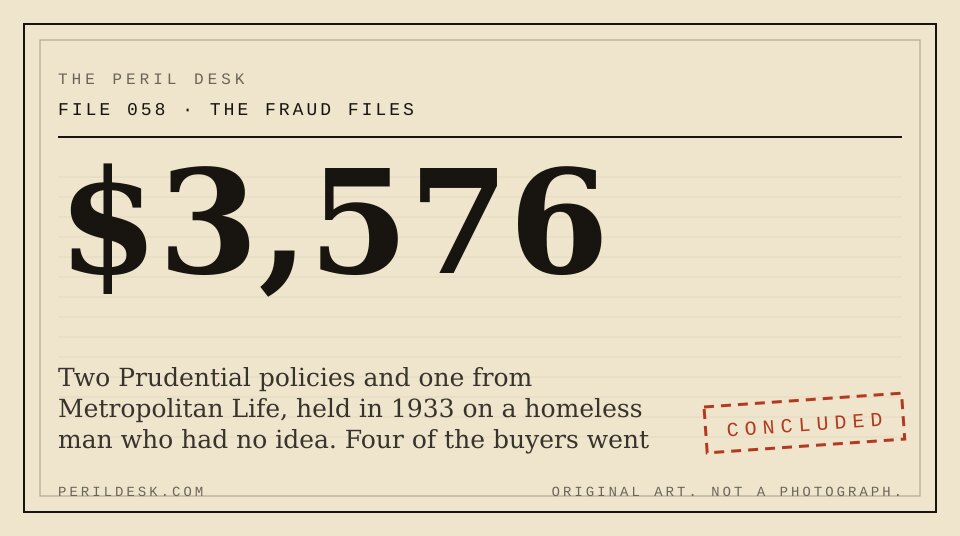
Three policies were taken out on Malloy’s life, totaling $3,576 by Smithsonian magazine’s count. Two were written by Prudential and one by Metropolitan Life. All three carried double indemnity, meaning the payout doubled for an accidental death.
Smithsonian put that sum at about $54,000 in 2012 dollars. Split several ways, in the fourth winter of the Great Depression, that was real money.
The men were ordinary in the way that makes the story worse. Tony Marino, 27, ran a speakeasy, an illegal bar during Prohibition. Francis Pasqua, 24, was an undertaker. Daniel Kriesberg, 29, kept a grocery. Joseph Murphy tended bar.
They did not need a weapon. They had a bar and a customer with nowhere to go.
The method that was supposed to be invisible
Marino gave Malloy an unlimited tab. He would give Malloy “all of the drink he wants,” Smithsonian quotes him saying, and let him “drink himself to death.”
That was the first plan. They were not planning a murder in their own minds. They were planning to let a man drink and then collect a check, and they had a story ready about how nobody had done anything.
Malloy drank most of his waking hours. He kept turning up. He kept standing.
So the group escalated, repeatedly, through January and February 1933. The contemporary accounts and later histories list a sequence of substitutions in his glass and his food that runs from industrial fluids to spoiled food packed with hardware.
What matters is the pattern: each escalation was more certain than the last, and each one ended with Malloy asking for another round.
The night the weather was supposed to do it
When the drinks failed, the group tried the cold.
On a January night they carried the unconscious Malloy to Crotona Park, opened his shirt, and poured a five-gallon jug of water over his head and bare chest.
He was found. A charity gave him new clothes. He came back to the bar.
They tried a taxi next. A cab driver named Harry Green was brought in to run him down. Malloy came back from that too.
What finally happened, and what it paid
Overnight on February 21 to 22, 1933, they killed him.
They took him to a rented room, ran a hose from a gas jet, and used it.
Then the plan met the paperwork, which the group had never thought about.
A death certificate was produced, giving the cause as lobar pneumonia. A burial was arranged quickly. And then the men went to collect, and found that a policy is not a check, it is a claim, and a claim gets read.
Metropolitan Life paid $800.
Weeks of attempts, three policies, and $800 of it actually arrived.
The catch
Word moved before the money did.
Malloy had been a known figure in the neighborhood, drinking free at one bar for weeks and surviving things that should have killed him. People talked. Police heard the talk.
On May 11, 1933, Malloy’s body was exhumed from Ferncliff Cemetery. The autopsy found carbon monoxide in his tissue, not pneumonia.
Prosecutors charged the group with first-degree murder in the Bronx. The press had a name for them by then, the Murder Trust, and the name stuck because it described the structure exactly: a small syndicate, formed to profit from one man’s death, with shares.
The trial opened in October 1933. The jury came back on October 19.
Francis Pasqua, Tony Marino, Daniel Kriesberg and Joseph Murphy were convicted of first-degree murder and sentenced to death. Harry Green, the driver, went to prison.
The four were executed in the electric chair at Sing Sing prison in June and July 1934. Four men, for $800 collected and one life taken.
The two words the case comes down to
The Malloy case attaches to two words: insurable interest.
Insurable interest is the rule that a policy buyer must stand to lose something real if the insured life or thing is gone. It is why a stranger cannot walk into an office and buy a policy on a neighbor.
The rule was already old in 1933. What the Murder Trust exposed was not a missing rule but a soft edge in how it was checked at the counter: whether anyone at the desk asked what a speakeasy owner and an undertaker stood to lose if a homeless man stopped breathing.
Nobody asked. The policies issued. The men found out the hard way that the industry’s real defense was not the application form, it was the claims investigation on the other end, and the electric chair after that.
Michael Malloy was not a punchline in his life. He was a man with no address in the fourth winter of the Depression, and the people he drank with decided his death was an asset. He survived every plan they had, and it took a hose and a rented room to end him.
The verdict and the execution dates, not the barroom legend, are what say how it finished.
Smithsonian magazine’s full account of the case, “The Man Who Wouldn’t Die,” carries the contemporaneous detail.