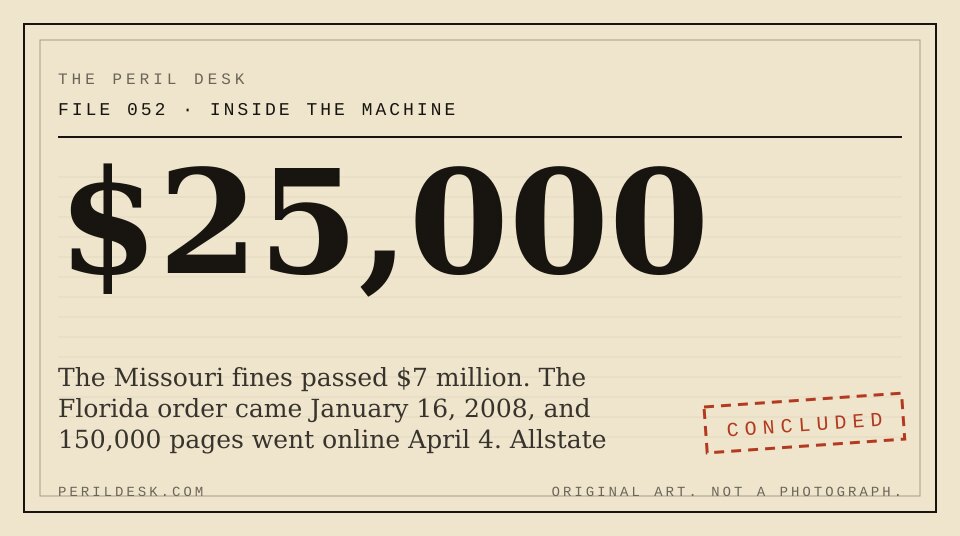
In September 2007 a judge in Jackson County, Missouri, held Allstate in contempt and started a meter: $25,000 for every day the company kept a set of McKinsey consulting slides out of a policyholder’s hands. The meter passed $7 million.
The slides stayed put.
On January 16, 2008, Florida’s insurance commissioner signed an order suspending Allstate’s certificates of authority to write new business in the state, over the same documents. Seventy-nine days later, roughly 150,000 pages went up on Allstate’s own website.
A daily fine is a line item. A suspended license is a business.
What the deck was
In the 1990s Allstate hired McKinsey & Company, the consulting firm, to review and redesign how the company handled claims.
The work product was PowerPoint. Allstate’s own counsel, in litigation over the slides, put the count at more than 20,000 slides created since 1992, and a company vice president’s affidavit later identified 127,574 pages of McKinsey documents.
David Berardinelli, a Santa Fe lawyer, came at it sideways. In 2000 he sued Allstate on a bad faith claim, meaning a claim that the insurer handled a policyholder unfairly rather than merely getting the math wrong.
Discovery is the stage of a lawsuit where each side must hand over documents. Through it he obtained, temporarily, 12,500 pages of the McKinsey slides.
He was not permitted to keep copies. So he read them, took notes for about two years, and published a book, From Good Hands to Boxing Gloves.
The title is his phrase, not a caption lifted off a slide. It compresses what he argued the strategy amounted to, and Allstate’s own trade-secret fight over the slides, in a case called Pincheira, reached the New Mexico Supreme Court in 2008.
The refusals
Berardinelli’s book did not put the documents in public. Two more fights did that, and neither went quietly.
In Missouri, a Hawaii policyholder named Paul Aldridge was suing Allstate in Jackson County. Judge Michael Manners ordered the company to produce its internal claims documents. Allstate refused.
In September 2007 Manners held the company in contempt, which is the sanction for disobeying a court order, and set the penalty at $25,000 for every day of non-compliance. By the time the case settled in July 2008 the fines had accumulated to more than $7 million, and the settlement terms were confidential. Insurance Journal’s account adds that the Missouri Supreme Court had ordered Allstate in November 2007 to turn over the documents, and that the company disclosed more than 120,000 pages of records. The contempt order still stood until July 23, 2008.
Then Florida. Insurance Commissioner Kevin McCarty had subpoenaed the McKinsey material as part of an inquiry into Allstate’s claims handling and rates, and called a hearing for the company to produce it.
Allstate came to the hearing without the documents. The next day, January 16, 2008, McCarty signed an immediate final order suspending the company’s certificates of authority to transact new insurance business in Florida until it produced them.
On January 17 he expanded the order from three auto units to all ten Allstate companies in the state and all lines of insurance. Allstate said it was “considering its options” and that it had “produced since mid-October over 40,000 pages of documents.”
The release, and what the company said about it
The suspension was stayed while Allstate appealed. On April 4, 2008, Florida’s First District Court of Appeal affirmed the order.
Within hours, Consumer Watchdog reported, Allstate produced the documents to Florida and then went further, posting them on its own media website. The release ran to approximately 150,000 pages.
Allstate framed the release as a correction of the record, not a concession. It said it needed to “address misunderstandings resulting from the growing misplaced focus by our critics on very small pieces of the whole.”
Its statement said that “public criticisms by people with a vested interest in creating an inaccurate picture of the company’s claim practices have been based unfairly on only snippets from the documents taken out of context.”
That response belongs in the file next to everything else. The Missouri contempt order, the Florida suspension and the New Mexico trade-secret case were all fights over producing the slides, not rulings on what the slides recommended.
What the slides recommended, and what critics say the slides recommended, are two different documents in this story. The first is 150,000 pages and public. The second is an argument.
Consumer Watchdog, reviewing the release a week later, reported that Allstate had filed objections to 196 pages as privileged or trade secret. Florida’s order, as the appeals court summarized it, leaned on a consumer-group report alleging Allstate used a claims program that cut bodily injury payouts by up to 20 percent without adequately examining each claim. Allstate has not conceded that reading.
Eight years, a contempt finding, a suspension
Roughly eight years passed between one lawyer’s 2000 filing and the April 2008 release. In between: a contempt finding, a fine that ran past $7 million, a state insurance commissioner’s subpoena, and the suspension of a national carrier’s new business in Florida.
That is a high price for keeping decade-old consulting slides sealed. Berardinelli’s argument is that the price was paid because of what the slides say. Allstate’s position, in its own statement, is that critics read snippets out of context; in New Mexico it argued the slides were trade secrets. Both readings survive the record as it stands.
What does not survive is the idea that this was a leak. The documents came out through discovery, then a court order, then a regulator’s order, then the company’s own website.
Every step is a filed instrument with a date on it. That is the reason this story is tellable at all.
Why the regulator reached for the license
State insurance departments cannot indict. Their lever is the license to sell.
A market conduct examination, which is a state review of how a company treats its policyholders, runs on documents the company hands over. When the documents do not arrive, the department’s realistic options narrow to one.
McCarty used it. The appeals court affirmed his order on April 4, 2008, affirmed it again on rehearing on May 14, and lifted the stay. The suspension ended only after Allstate signed an affidavit that it had turned over the records and would comply with future requests.
The Missouri fines had been running for four months when Florida acted, without producing the same result. On July 23, 2008, Insurance Journal reported, the Missouri judge threw out the contempt order, and the more than $7 million in fines with it, after finding the company had complied.
The lever that worked cost Allstate nothing in fines and everything in new Florida policies for as long as it held. The order that did it is docket 1D08-0275, and the release it produced is still the primary record, 150,000 pages long, with this summary and every other one sitting downstream of it.