The Camp Fire started on the morning of November 8, 2018, in Butte County, California.
The California Department of Insurance called it the deadliest and most destructive fire in California history. The liquidation petition later filed against one insurer described it as having burned about 153,000 acres and destroyed 18,793 structures as of November 26.
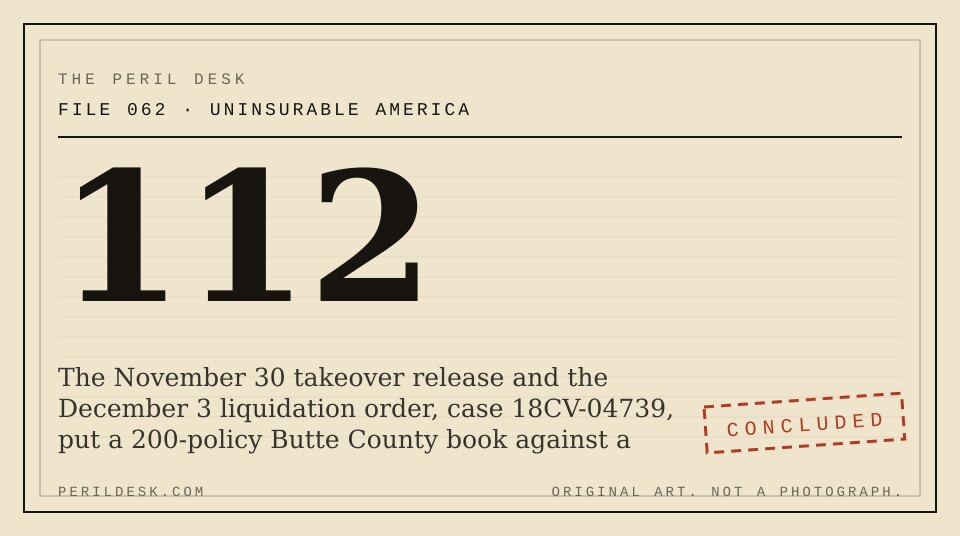
Twenty five days after it started, a court in Merced County signed an order ending a company that had been writing insurance policies for 112 years.
The fire burned in Butte County. The insurer sat in the Central Valley, well outside it. Only one of them was still standing in December.
The company
Merced Property and Casualty Company was based in Atwater, in the Central Valley, a long way from Butte County.
It was small by design. A regional property insurer with a book of homeowners business, the kind of company that does not appear in national rankings and never intended to.
A company like that writes in the places larger carriers find dull, knows its territory, and depends on losses arriving in a scatter rather than all at once.
Merced had been doing it for 112 years by 2018. In Butte County, the ABC30 report of the takeover put its book at 200 policies.
The twenty five days
The timeline is taken from the state’s filings and the fire record.
November 8, 2018: the Camp Fire ignites.
November 30, 2018, day 22: California Insurance Commissioner Dave Jones announces that his department has filed an expedited request with the Merced County Superior Court to take over the company, and designates the state’s Conservation and Liquidation Office to manage it.
December 3, 2018, day 25: the Merced County Superior Court enters an Order Appointing Liquidator in Insurance Commissioner of the State of California v. Merced Property and Casualty Company, case number 18CV-04739.
Liquidation is a court ordered wind down, which means the company stops existing as a going concern and its affairs are settled under state supervision.
A 112 year old insurer and a 25 day file. Those two spans do not belong in the same sentence, and in December 2018 they did.
What the commissioner said
The department did not present the takeover as a routine regulatory step.
“California law gives us the authority to take over insurance companies that face insolvency,” Jones said in the November 30 announcement. “Protecting Camp Fire policyholders who have already suffered through so much was my first consideration.”
That is the sentence that explains the speed. A company that cannot pay is worse for its policyholders every day it keeps trying.
The two numbers that ended it
Insolvency has a plain arithmetic behind it, and in this case the arithmetic was not close.
Merced Property and Casualty told the Merced County court it expected to owe about $64 million in claims from the Camp Fire.
The company’s assets totaled about $23 million.
The gap was about $41 million, on a book that had been solvent and unremarkable a month earlier.
Surplus is the cushion an insurer holds above its expected claims, and it is sized for a normal bad year. It is not sized for a single event that destroys an entire town inside a company’s writing territory.
KMPH reported Merced as the first insurance company to fold after the Camp Fire. The state did not wait to see whether it would be the last.
Who paid the claims
The policyholders did not lose their claims.
When a California insurer is found statutorily insolvent, the California Insurance Guarantee Association steps in. CIGA is a state backstop fund, financed by assessments on other licensed insurers, which pays covered claims when a member company fails.
Once the insolvency finding was made, CIGA began evaluating losses and paying covered claims, in the liquidation order’s words, “up to statutory limits.”
Those limits matter. The guaranty association does not simply become the failed insurer. It pays covered claims up to a statutory ceiling, and a total loss on a substantial home can exceed that ceiling.
So the honest description is not that everyone was made whole. It is that the claims did not vanish with the company, and that the rest of the industry paid for the shortfall through assessments.
The estate page kept by the Conservation and Liquidation Office recorded the scale of that work as of December 31, 2019: approximately $71.2 million in loss payments to insureds and loss expenses, with another $7.8 million in case reserves expected to develop over the following quarters. The same page records about $3 million in unearned premium refunds paid by CIGA and a $26.6 million proof of claim the estate filed in the Pacific Gas and Electric bankruptcy.
Loss payments and loss expenses alone had passed $71 million by the end of 2019. That is a different measure from the $64 million claims estimate the company gave the court in December 2018, and it is the larger number.
The estate page lists a closure date of November 18, 2025, the day a declaration was filed confirming the distribution of estate assets under court order and closing the estate.
What kind of failure this was
A single fire bankrupting a single insurer is not, on its own, a national story.
The shape of the Merced failure is what sets it apart from an ordinary insolvency.
The company was not reckless. Nothing in the record describes fraud, bad underwriting or a hidden hole in the books. It was an ordinary regional insurer, doing an ordinary thing, that met an event of a size its arithmetic had never contemplated.
That is a different failure mode from the ones insurance regulation was originally built to catch. Regulators watch for companies that are weak. Merced was not weak. It was concentrated.
Concentration is the risk that geography creates. A regional insurer is regional. When the catastrophe lands inside the region, the diversification that makes insurance work is simply absent.
What it changed
The Camp Fire arrived at the front of a long California argument about wildfire and who can carry the cost of it.
Merced sits at the start of that sequence as a plain illustration of the underlying problem. One fire, one company, twenty five days.
The century of quiet years before it did not count for anything on the balance sheet in December.