A federal flood policy bought today does not cover a flood tomorrow. It does not cover a flood next week either.
The National Flood Insurance Program’s rule, at 44 CFR 61.11(d), makes a new policy effective at 12:01 a.m. on the 30th calendar day after the application date and the payment of premium. It exists so that nobody can buy protection while watching a storm on radar.
Hurricane Harvey’s center came ashore on San Jose Island near Rockport, Texas at 0300 UTC on August 26, 2017, which is 10 p.m. on August 25 in Texas, as a Category 4 hurricane. Every household that reached for a flood policy in the month before August 25 was already too late.
The rule, in one paragraph
The regulation gives its own example: a policy applied for and paid on May 1 takes effect at 12:01 a.m. on May 31. Three exceptions sit beside it. Coverage bought in connection with making, increasing, extending or renewing a loan takes effect at the loan closing. During the 13 months after a community’s flood map is revised, a first policy takes effect the next day. And a first policy on a property affected by flooding on federal land after a wildfire takes effect the next day if bought within 60 days of the fire’s containment.
Outside those exceptions, the calendar is the calendar. Day 30 is day 30.
That single paragraph is the whole mechanism. The rule is simple. What the rule collided with in Harris County is not.
What the county actually held
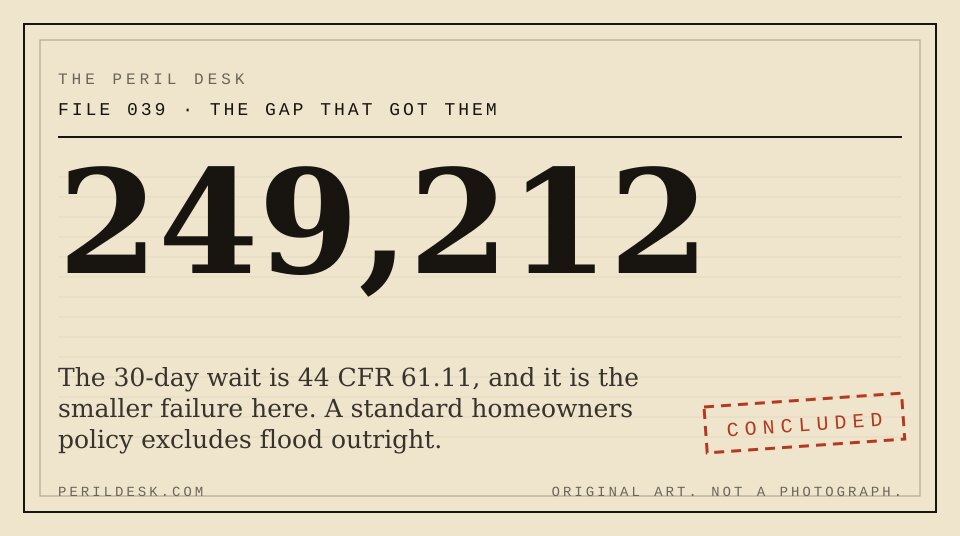
Before the storm, the coverage was already counted. As of June 30, 2017, Harris County policyholders held 249,212 NFIP flood insurance policies, covering $70.34 billion in assets and generating $138.4 million in annual premiums, according to an analysis of federal program data by three University of California, Davis researchers.
That is a real number and a large one.
Set it beside the county’s own count of what it had to protect. When Harris County launched a billboard campaign the following spring, it said that more than 80 percent of its 1.4 million buildings had lacked flood insurance when Harvey struck.
It was nowhere near enough, and the reason is not the obvious one.
The wait was not the main problem
The 30-day rule catches the household that tried at the last minute. It is a vivid failure, and it is a small one by count.
The larger failure was structural, and it happened years before Harvey formed.
The Davis analysis, by Nicholas Pinter, Nicholas Santos and Rui Hui of the university’s Natural Hazards Research and Mitigation Group, was published on September 1, 2017, while the water was still draining. It found that about two-thirds of the inundation in Harris County fell outside FEMA’s Special Flood Hazard Area. That zone is the officially mapped high-risk band, the one commonly called the 100-year floodplain.
It found something else. More than half of the estimated inundation was outside any mapped flood zone at all.
Outside the high-risk band, no lender is required to demand flood insurance. Nothing in the system tells the household on that street that water is coming for it.
So the households the map missed were not late buyers. Most of them were never told there was anything to be late for.
Two different ways to be uninsured
There is the household that knew, waited and missed the window by days. That story is about a rule.
There is the household that never appeared on a risk map, was never required to carry anything, and never priced the possibility. That story is about a map.
How many Harris County households fell into each category is not settled by any single federal tally. The county’s own figure, more than 80 percent of 1.4 million buildings without flood insurance, is a campaign estimate, not a count.
What the record does carry is the map. About two-thirds of the flooded area sat outside the band the system uses to decide who has to buy anything.
Why a homeowners policy did not help
A standard American homeowners policy excludes flood. Not limits it. Excludes it. The federal government’s own consumer sheet, posted at Ready.gov, is titled “Homeowners Insurance Does Not Cover Flooding,” and the Insurance Information Institute puts it in one line: floods “are not covered under homeowners and renters policies.”
Flood is a separate purchase, and the National Flood Insurance Program is the federal seller.
That means a Harris County household could have been fully current on a homeowners policy, fully current on a mortgage, and still receive nothing at all for four feet of water in the living room. The coverage was never in that document.
The 30-day rule is not a villain
The waiting period has a purpose.
Without a wait, flood insurance stops being insurance. Nobody buys until the cone of a storm covers the county, everyone claims at once, and there is no pool of premium to pay from. The wait is what keeps the program from being a lottery ticket sold at the last second.
The rule is doing exactly what it was designed to do. The complaint against it is not that it exists. The complaint is that its existence is invisible to the household right up to the week it matters.
Federal regulation says 30 days. Nothing in the ordinary experience of buying a house says it out loud at the moment it would count.
What the county looked like afterward
Harvey rewrote the local math. An Associated Press report published July 31, 2018 put the increase in Texas flood insurance policies at more than 18 percent from July 2017 to the end of May, with a near 23 percent jump in Harris County and a 54 percent increase in Fort Bend County.
In April 2018, Harris County sought $75,000 in federal grant money for billboards telling residents outside the floodplains that hurricane season runs June to November but flood season runs all year. The 80 percent figure came from that campaign.
A map revision is the closest thing this system has to a warning letter. It changes who is required to carry coverage, which changes who is standing outside the program the next time a storm parks over Southeast Texas for days.
The two dates that decide everything
For a flood policy, only two dates matter. The date of purchase, and the 30th day after it.
Harvey’s Texas date was August 25, 2017. Every purchase date after July 26 that year was outside the window, counting back 30 days from the landfall date under the federal rule.
That arithmetic is not cruel. It is just fixed, and fixed rules are the ones that catch people who did not know the rule was running.
The federal waiting-period rule and the Harris County policy counts are linked in Sources below.