Gene Lokken was 91 years old when he fell at home and fractured his leg and ankle. His family alleges that a computer model, not his doctor, decided when his rehab coverage stopped.
That allegation sits in a federal complaint filed in Minnesota on November 14, 2023. The same complaint alleges something stranger about the denials the model produced.
When people fought them, the complaint says, the denials fell apart more than nine times out of ten.
Nineteen days, then the file closed
Lokken fell on or around May 5, 2022, according to the complaint. After a hospital stay he was admitted to a skilled nursing facility in Wisconsin, meaning a rehab center with nursing care around the clock.
The complaint says his UnitedHealthcare plan covered his post-acute care there from July 1 to July 20, 2022, then stopped. STAT counted it as 19 days of therapy.
The plan was Medicare Advantage, which means a private plan that stands in for original Medicare. The federal government pays the insurer a set amount. The insurer decides what gets approved.
Lokken stayed in the facility, with his family paying $12,000 to $14,000 a month by the complaint’s account, until he died on July 17, 2023. His estate is a named plaintiff.
The model has a name
The complaint names the tool: nH Predict. It was built by naviHealth, a company UnitedHealth Group acquired in 2020 for $2.5 billion, the complaint says.
The families allege the model produced a projected length of stay for post-acute patients, meaning people recovering after a hospital discharge. They allege that projection functioned as the cutoff date.
They allege staff who departed from the model’s target faced internal pressure to stay close to it.
Those are allegations. No court has ruled on whether the model worked the way the complaint describes.
The number the plaintiffs put on the record
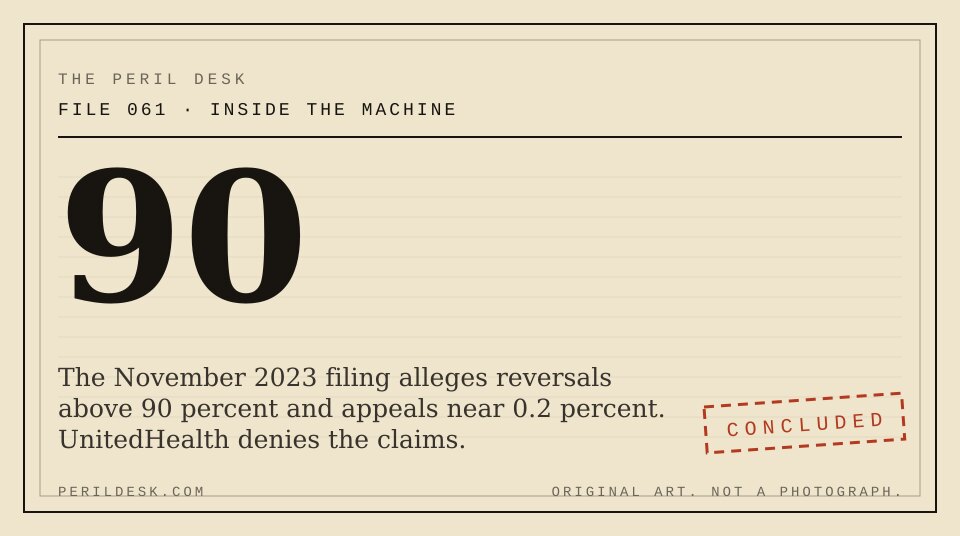
The plaintiffs allege that UnitedHealth knew the model was inaccurate because, as the complaint pleads “upon information and belief” at paragraph 38, “over 90 percent of patient claim denials are reversed through either an internal appeal process or through federal Administrative Law Judge (ALJ) proceedings.”
An Administrative Law Judge is a federal officer who hears Medicare appeals. “Information and belief” is the phrase a pleading uses for a figure the plaintiffs believe but have not yet proved.
That reads as a scoreboard. When a denial got a second look from a human with authority, the complaint says, the denial lost about nine times in ten.
A ratio like that usually means one of two things. Either the appeals process is broken in the patient’s favor, or the original decision was wrong most of the time.
The contradiction
The second number sits beside it.
The same complaint alleges, at paragraph 2, that roughly 0.2 percent of policyholders ever challenged a denial. Two in a thousand.
So the alleged 90 percent is on the record and almost weightless at the same time. It describes what happens inside a door that hardly anyone opens.
A denial reversed at that alleged rate still stands, permanently, for the 998 families who never filed. The complaint’s theory is that this gap was not an accident of the design. It was the design working.
What the reporting found first
The lawsuit did not arrive from nowhere.
On March 13, 2023, STAT published an investigation by Casey Ross and Bob Herman into naviHealth and its length-of-stay targets, headlined “Denied by AI.” The complaint cites it by name. The reporting described case managers working against the model’s projected discharge dates.
The complaint followed eight months later and covers similar ground. Both are documents in the public record. Neither is a verdict.
The company’s answer
UnitedHealth Group has denied the claims.
In an emailed statement to STAT on November 14, 2023, the company said: “The tool is used as a guide to help us inform providers, families and other caregivers about what sort of assistance and care the patient may need both in the facility and after returning home.”
To Healthcare Dive the next day it said: “Coverage decisions are based on CMS coverage criteria and the terms of the member’s plan. This lawsuit has no merit, and we will defend ourselves vigorously.”
That denial belongs in the same file as the allegation, and it is not a technicality. The whole dispute is about whether a projection is a suggestion or a decision.
Where the case actually stands
On February 13, 2025, Judge John R. Tunheim of the District of Minnesota ruled on the motion to dismiss.
Five of the seven counts in the original complaint were dismissed. Two survived: breach of contract, and breach of the implied covenant of good faith and fair dealing, meaning the duty to deal honestly under a contract already signed.
That is not a finding that the algorithm did anything. It is a finding that two of the plaintiffs’ legal theories can proceed to be tested.
The other five theories, including several statutory and consumer-protection claims, are out.
Then, on March 9, 2026, Magistrate Judge Shannon G. Elkins ordered UnitedHealth to open its files. By the account of the law firm ArentFox Schiff, the order covers its policies on post-acute care claims, its documents analyzing nH Predict, the business documents behind the naviHealth acquisition, materials from government investigations, performance reviews and compensation data for care coordinators and medical directors, the records of its internal AI review board, and the identities of the medical directors and care coordinators who took part in denying coverage to 300 putative class members.
Why an insurance file, not a tech file
This case gets filed under software, and that is the wrong drawer.
The mechanism in dispute is ordinary claims handling. A projection gets made. A cutoff date follows. An appeal right exists on paper and, the complaint alleges, is used by two people in a thousand.
Swap the model for a clipboard and the shape does not change. What the model adds is speed and uniformity, applied to a population that is elderly, mid-recovery, and least able to file paperwork against a deadline.
The complaint’s 90 percent figure is an allegation about that population. So is the 0.2 percent.
What discovery would have to produce
Discovery is where allegations either grow teeth or die quietly. The March 2026 order gives the plaintiffs a path to the internal records that would show what the model produced and what happened next.
Whether those records say what the complaint says is a docket question, not a moral one.
Until then the honest summary is short. A federal complaint alleges an algorithm set rehab cutoffs for seniors. It cites a reversal rate above 90 percent and an appeal rate near zero. The company denies it. A judge has let two counts stand, and a magistrate has ordered the files opened.
The complaint, the February 2025 order and the discovery order are public filings, and all three are linked in the Sources block below.