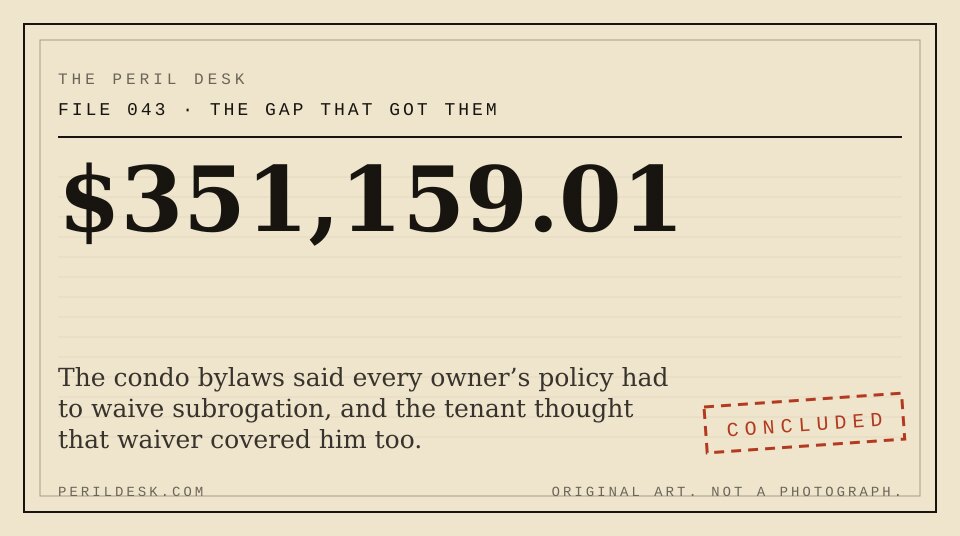
On the morning of May 27, 2013, a man in Boston turned on the bathtub faucet in his master bathroom, went into a bedroom, lay down and fell asleep. The claim that followed him out of that apartment was $351,159.01.
The tenant was John Deming. The apartment was Unit 1801 at 1 Huntington Avenue, in the Trinity Place Condominium, which the trade site Agency Checklists places on Copley Square next to the Boston Public Library. He had rented it since 2010.
When he woke, the district court’s stipulated facts record, the faucet “was still running, and the water was overflowing the tub.” Water went over the rim, through the floor, and into the units underneath.
One of those units was 1601. Its owners had a policy with Pacific Indemnity Company. Pacific paid them $351,159.01.
Then Pacific went looking for the person who left the water running.
The move has a name
What Pacific did next has a name. It is called subrogation, an insurer’s right to chase whoever caused the loss.
The idea is simple. An insurer pays its own customer first, so the customer is not left waiting. Then the insurer steps into that customer’s shoes and sues the party at fault to get the money back.
Pacific sued Deming personally in federal court in Massachusetts. It asked for $351,159.01, plus interest and costs. Deming did not contest the cause. “It is undisputed,” the district judge wrote, “that Deming was negligent in allowing his bathtub to overflow.”
That is the number that makes this a case file instead of a plumbing story. The water came out of a tub in one apartment. The bill arrived at one person.
The clause he thought protected him
Deming did not argue that he had left the tub running by accident. He argued that the building’s own rules had already closed the door on Pacific.
The condominium’s bylaws said each unit owner “shall carry insurance.” They also said that “all such policies shall contain waivers of subrogation.”
A waiver of subrogation is a promise not to chase. When an owner’s policy carries one, the insurer gives up the right to turn around and sue a listed party after paying a claim.
Deming’s position was that the bylaws made that waiver mandatory across the building. If every owner’s policy had to waive subrogation, he said, Pacific never had a right to come after him at all.
The district court agreed with him. On October 16, 2015, Judge Leo T. Sorokin granted summary judgment in his favor, which means the judge ended the case before any trial, and ordered the action dismissed with prejudice, each side bearing its own costs.
For a moment, the $351,159.01 was gone.
What the appeals court found in the same words
Pacific appealed. On July 5, 2016, the First Circuit Court of Appeals reversed, in Pacific Indemnity Co. v. Deming, No. 15-2386.
The court read the bylaws, the master deed, and the declaration of trust, and it found the plain language did not say what Deming needed it to say. The required waivers of subrogation applied to unit owners. They did not extend to tenants.
Deming lived in the building. He did not own a unit in it. The document that was supposed to shield him was written around a category he was not in.
The court then added a second reason, and it is the harder one for tenants. Even if the bylaws had required owners to buy policies waiving subrogation against tenants, there was, in the court’s words, “no evidence that Unit 1601’s owners actually waived their insurer’s subrogation rights against tenants.”
A rule on paper is not a policy in force. Nobody had checked. So Pacific’s claim was allowed to go forward.
The gap this case marks out
A building’s insurance is bought by and for the people who own the building. A tenant lives inside all that coverage without being a party to it.
When something in a rented unit causes damage below, the owner’s insurer pays the owner, and then it looks for someone to bill. A tenant is a very reachable someone. They have a name on a lease and an address on file.
The liability section of a renters policy exists for that exact moment. It answers a claim made against the renter by somebody else. The contents section is what replaces the renter’s own furniture.
The appellate record in Deming turns on the waiver language and the missing proof, not on what insurance Deming did or did not carry. Neither opinion says whether he had a renters policy, and this file does not pretend to know.
What the record does establish is the exposure. One sleeping tenant, one running tap, and a federal appeals court holding that a $351,159.01 subrogation claim against him could proceed.
Where the file stops
Reversed and remanded means sent back down. It does not mean judgment entered.
The First Circuit decided that Pacific could pursue the claim. It did not decide how much, if anything, Deming ended up paying. That part is not in the appellate opinion, and this file will not guess at it.
The number that survives is the number Pacific asked for, and the ruling that survives is the one that let it ask. The district court’s stipulated fact number one still reads: “On the morning of May 27, 2013, defendant John Deming turned on the bathtub faucet in the master bathroom of Unit 1801, 1 Huntington Avenue, Boston, Massachusetts.”