Two sisters spent the months after Hurricane Katrina adjusting storm claims on the Mississippi coast for a State Farm contractor. In April 2006 they filed a complaint under seal.
More than ten years later the Supreme Court of the United States decided whether the case that complaint started could survive. It could.
The sisters are Cori Rigsby and Kerri Rigsby. They were, in the Supreme Court’s words, “former claims adjusters for one of petitioner’s contractors, E. A. Renfroe & Co.” Katrina had come ashore on the Gulf Coast near Buras, Louisiana, at 1110 UTC on August 29, 2005, and made its final landfall at the Louisiana and Mississippi border.
They sued under the False Claims Act, a law that lets private citizens sue on the government’s behalf when someone bills the government falsely.
The case is State Farm Fire and Casualty Company v. United States ex rel. Rigsby. The final opinion sits at 580 U.S. 26 (2016).
The two policies on one house
To see what the sisters said they saw, hold two pieces of paper next to each other.
One house on the Mississippi coast carried both. A homeowners policy covering wind damage, sold and paid by a private insurer. A separate flood policy through the National Flood Insurance Program, the federal flood insurance system.
State Farm sat on both sides. It wrote the homeowners policies with its own money, and it also acted as a Write Your Own carrier, meaning a private carrier selling federal flood policies.
On a flood claim, the money that goes out is federal money. On a wind claim, the money is the insurer’s own.
Katrina put both perils on that coast in the same hours. The National Hurricane Center recorded a storm surge of 17 to 22 feet along the eastern half of the Mississippi coast, from Gulfport to Pascagoula, and a gust of 108 knots at the Jackson County emergency operations center in Pascagoula.
That is the seam the case ran along.
What the sisters alleged, and what a jury was asked
The Rigsbys alleged, in the Supreme Court’s summary, that State Farm “instructed them and other adjusters to misclassify wind damage as flood damage in order to shift petitioner’s insurance liability to the Government.”
Broad allegations are not what juries decide. The district court, in the Fifth Circuit’s words, “focused discovery and the subsequent trial on the McIntosh claim, rather than permitting the Rigsbys to seek out and attempt to prove other claims.”
The house belonged to the McIntosh family in Biloxi, Mississippi. The McIntoshes held both policies with State Farm, and under the flood policy State Farm paid the maximum, $250,000 for the home and $100,000 for personal property.
At trial the Rigsbys put on evidence that wind, covered by the company’s own homeowners policy, was responsible for the loss. A forensic engineer’s report dated October 12, 2005, concluded the damage was primarily wind. The Fifth Circuit recorded that a note on that report read “Put in Wind file” and “DO NOT Pay Bill DO NOT discuss,” and that State Farm commissioned a second report, which found water the primary cause.
The jury’s answer
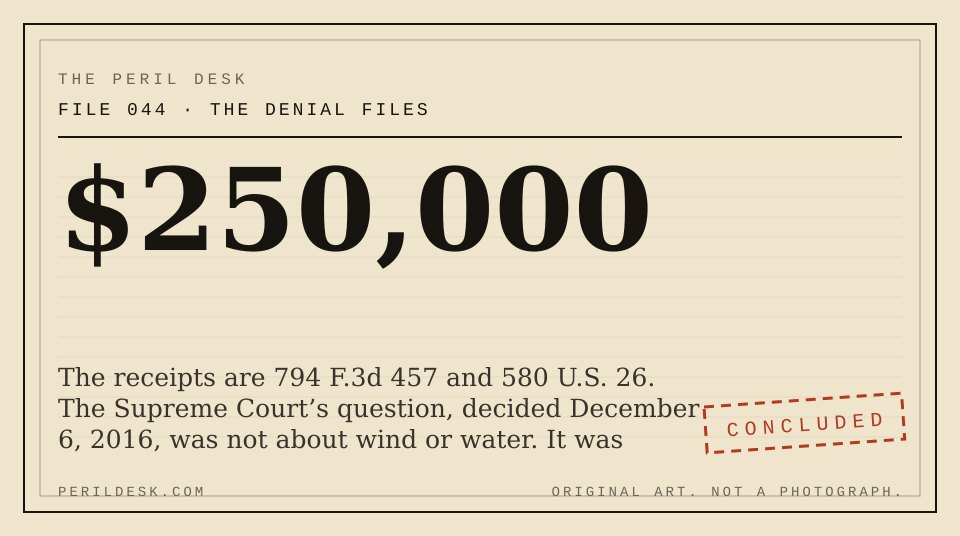
The jury, in April 2013, “concluded that the McIntosh residence sustained no compensable flood damage and that the government therefore suffered damages of $250,000.”
That is the finding the whole file rests on. Not that flood damage was overstated, and not that the paperwork was sloppy. No compensable flood damage, on a dwelling claim billed to the federal flood program at its full $250,000 limit.
Under the False Claims Act, a false claim is trebled, which means the damages figure is multiplied by three. The district court trebled the $250,000 to $750,000, added a civil penalty of $8,250, and entered $758,250. It awarded the sisters 30 percent, or $227,475, which the Fifth Circuit called “the maximum possible share under the FCA for relators pursuing claims without the government as a party.” The statute sets the share in a case the government declines at “not less than 25 percent and not more than 30 percent.”
State Farm contested the case at trial and on appeal. On July 13, 2015, the Fifth Circuit affirmed the judgment.
The technicality that nearly ended it
Then the case went to Washington on a question that had nothing to do with wind or water.
The False Claims Act requires that a whistleblower’s complaint be filed under seal, meaning kept secret from the public for a set period. The point of the seal is to let the government investigate quietly before the defendant knows.
In the Rigsby case, the seal was broken. The sisters’ then-attorney, Dickie Scruggs, “e-mailed a sealed evidentiary filing that disclosed the complaint’s existence to journalists at ABC, the Associated Press, and the New York Times.” The seal was lifted in full in August 2007, and the government declined to intervene.
State Farm argued that a seal violation should require dismissal of the complaint, full stop. Had that argument won, the verdict and the finding behind it would have gone away on a filing rule.
December 6, 2016
The Supreme Court ruled against that reading. A violation of the False Claims Act’s seal requirement does not mandate dismissal of the relator’s complaint.
Justice Kennedy delivered the opinion for a unanimous Court. The judgment below stood, and with it the jury’s finding about the McIntosh house.
So the record now reads in a single line. A federal jury found that a claim billed to the federal flood program was false, an appeals court affirmed it, and the Supreme Court declined to erase it over a broken seal.
What the file does and does not say
The verdict covered one claim on one house. The wider allegations about how Katrina claims were sorted across the coast were not tried to verdict here, and this file does not treat them as findings.
The seal ruling reaches past insurance. The 2016 opinion took one procedural defense away from every False Claims Act defendant, not only insurers.
The receipts, and where they live
The Fifth Circuit opinion, the Supreme Court opinion, and the docket number, No. 15-513, are all public.
The Supreme Court’s syllabus ends the way the case did: “794 F. 3d 457, affirmed. KENNEDY, J., delivered the opinion for a unanimous Court.”