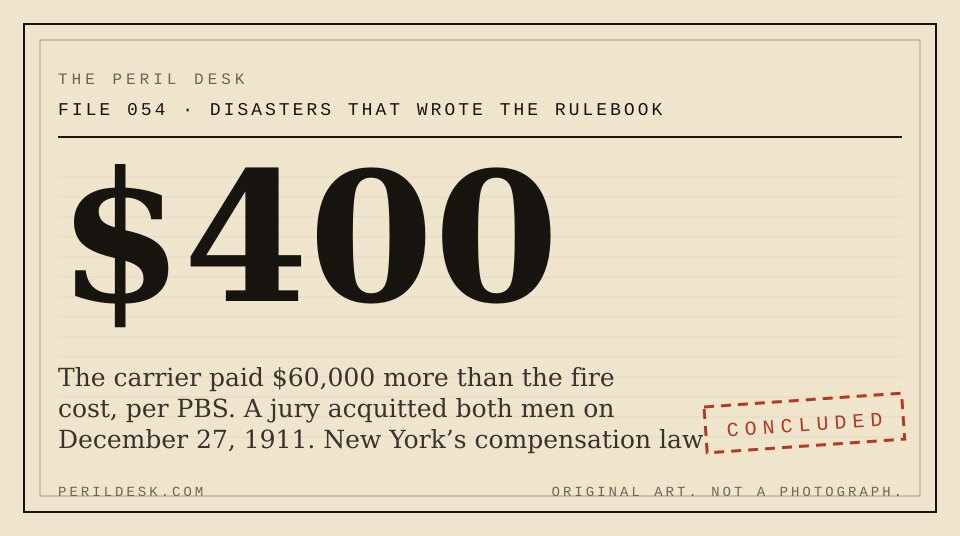
One fire in 1911 produced two prices for the same dead person.
The insurance carrier paid the factory’s owners $60,000 more than the fire had cost them, which PBS’s American Experience put at “a profit from the fire of $400 per victim.” Two years later the families’ civil claims settled at $75 a life.
Both numbers survive in the record. Side by side they show what a garment worker’s death was worth to the two parties who had a financial interest in it.
New York rewrote its constitution within three years.
The eighth, ninth, and tenth floors
The Triangle Waist Company occupied the top three floors of the Asch Building in Manhattan, at Greene Street and Washington Place. It made shirtwaists, the tailored blouses that were the standard uniform of working women, and by 1908 its sales had passed $1 million a year.
On March 25, 1911, a fire started on the eighth floor late in the workday. It killed 146 people, most of them young immigrant women, many of them teenagers.
The stairwell doors were locked, a practice the owners used to prevent theft. The firefighters’ ladders, History.com notes, “reached just below the seventh floor, and the fire was on the eighth floor.”
Workers trapped inside began to jump from the windows. That detail is why the fire never left American memory, and it is also why the follow-on numbers are so hard to look at.
What the policy paid
Isaac Harris and Max Blanck owned the Triangle. Their factory turned out more than 1,000 shirtwaists a day, which PBS’s American Experience calls the largest manufacturer of blouses in New York, and the trade called them the “Shirtwaist Kings.”
After the fire the two men, in PBS’s words, “collected a large chunk of insurance money,” which PBS puts at $60,000 more than the fire had actually cost them in damages. Leon Stein’s history The Triangle Fire, as summarized on Wikipedia, gives the excess as $64,925, about $445 per casualty.
Either way the recovery exceeded the documented loss. In plain terms, the fire paid.
History.com states the rate flat: Blanck and Harris “were paid $400 per worker’s death by their insurer.”
The trial that ended in an acquittal
Harris and Blanck posted $25,000 bail, hired Max Steuer, and stood trial for manslaughter over the locked ninth-floor door. The jury heard more than 100 witnesses.
On December 27, 1911, after an hour and forty-five minutes, it returned not guilty. The New York Times printed the judge’s charge the next morning: the jury had to find that the door was locked “with the knowledge of the defendants,” and that “such locking caused the death of Margaret Schwartz.”
No court found the two men criminally responsible for the deaths.
The civil docket was a separate track, and it moved slowly.
Seventy-five dollars
The families’ civil claims, Kevin Volk wrote in a paper for the New York courts’ historical society, “amounted to approximately one-half million dollars, but they were all settled out-of-court with the building’s owners for seventy-five dollars per life lost.”
Accounts differ on whose check it was. Volk says the building’s owners; History.com’s main entry names him, Joseph J. Asch. Wikipedia says Harris and Blanck were found liable for wrongful death in 1913 and paid the $75 per victim; History.com’s labor-law piece says “they eventually paid $75 in compensation to each victim’s family”; PBS describes a March 1913 settlement in which the factory owners “paid out a week’s worth of wages for each worker.”
Seventy-five dollars in January 1913 has the buying power of $2,555.49 in July 2026, by the Bureau of Labor Statistics’ own calculator. The bureau’s series starts in 1913, so no 1911 conversion exists.
So the ledger closed like this. The carrier’s payment worked out to $400 or more per death above the owners’ losses. The families got $75. Volk’s arithmetic: the owners “were paid more than five times that amount.”
Later in 1913 Blanck was arrested again for locking a factory door during working hours. He was fined $20, which Wikipedia notes was the minimum the court could impose.
The commission that read the ruins
New York’s response came from a legislative body created in the aftermath, not from the criminal courts.
The State Factory Investigating Commission was chaired by State Senator Robert F. Wagner, with Assemblyman Al Smith as vice chairman. Frances Perkins, who had watched the fire from the street, worked alongside them on the reform push.
The commission did not theorize. It held hearings around the state, interviewed 222 witnesses, took 3,500 pages of testimony, and its findings led to thirty-eight new laws regulating labor in New York State.
That is the durable answer to the question of what the fire changed. It changed the building code and the inspection power behind it.
The law that replaced the number
The deeper change was to the arithmetic itself.
Before compensation law, a worker’s family had one road: sue the employer and prove negligence. That is the road that ended at $75.
New York had tried to close it before the fire. A 1910 compulsory compensation act for hazardous trades was struck down by the state’s own Court of Appeals in Ives v. South Buffalo Railway Co., 201 N.Y. 271, on March 24, 1911, one day before the fire, because the law “authorizes the taking of the employer’s property without his consent and without his fault.”
The state answered with a constitutional amendment, adopted by the voters in 1913 and effective January 1, 1914, and a new Workmen’s Compensation Law enacted in December 1913 and re-enacted in 1914, with compensation payments starting July 1, 1914. The United States Supreme Court upheld it in New York Central Railroad Co. v. White on March 6, 1917.
Compensation law replaced the lawsuit with a schedule. No proof of employer fault, a fixed benefit set by statute, and no jury deciding what a particular life was worth on a particular Tuesday.
Two lawful payments
A schedule is a cold thing. It is also the reason no family after July 1914 had to negotiate against an owner who had already been paid more for the fire than the fire had cost him.
The Triangle case is not evidence that insurance caused the deaths. The carrier paid a claim under the contract it had written.
The case is evidence of something narrower and harder. Two lawful payments, made two years apart under two different bodies of law, priced the same 146 people at $400 above losses and at $75, and only one of those bodies of law has since been rebuilt.
The building still stands at 23-29 Washington Place. New York University owns it, and three plaques on the southeast corner carry the names.