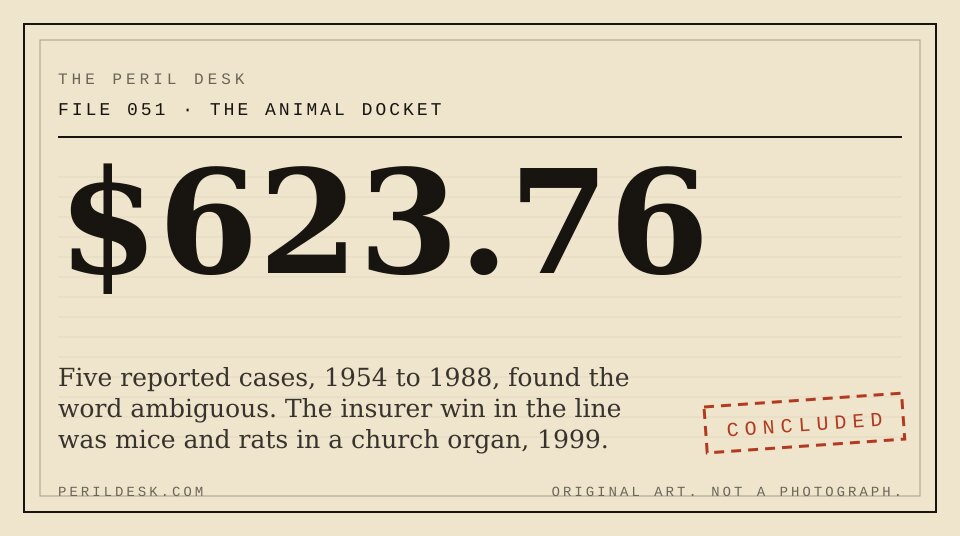
A raccoon got into Gertrude Marks’s house in Shreveport, Louisiana. The repair bill came to $623.76.
Trinity Universal Insurance denied the claim on one word in its exclusion list, “vermin,” and in 1988 the Louisiana Court of Appeal made it pay the claim, a $52.38 penalty and $1,500 in attorney fees.
That is the smallest case in a line of reported opinions that all turn on the same sentence. The homeowners wording the courts kept quoting excludes loss caused by “birds, vermin, rodents, insects or domestic animals.”
Two of those words do very different work. “Rodents” is a category with a hard edge.
“Vermin” is not.
The word that fails in court
An exclusion is the part of a policy that lists what the company will not pay for. It only works if it means something specific.
“Vermin” was never defined in the forms in front of these courts. So when carriers denied animal-damage claims on that word, policyholders sued, and the record is lopsided.
In 1954 a Georgia insurer argued that a squirrel was vermin by syllogism. The Court of Appeals of Georgia summarized the argument in North British & Mercantile Insurance Co. v. Mercer as “All squirrels are rodents. Rats, mice, and other rodents are vermin. Therefore, squirrels are vermin,” and affirmed a verdict for the homeowner that included a bad-faith finding against the company.
The Supreme Court of Georgia agreed that October. Its sentence is the hinge of the whole line: it “does not follow” that animals “admittedly not ‘rats, mice, etc.,’ but are squirrels, must be vermin because a squirrel belongs to the order of rodentia.”
In 1962 the New York Court of Appeals took up carpet beetles that had eaten what the opinion lists as “an 18th Century Aubusson tapestry,” antique armchairs and imported broadloom. In Sincoff v. Liberty Mutual Fire Insurance Co. the entomologists disagreed about whether a beetle is vermin, the dictionaries disagreed too, and the court reinstated the $2,000 judgment for the owners.
In 1981 the Civil Court of the City of New York took up raccoons that moved into a house in the fall of 1978 and stayed until May 1979. In Umanoff v. Nationwide Mutual Fire Insurance the policy excluded “birds, domestic animals, termites and other insects, or vermin.” Raccoons, the court held, are not vermin, and the homeowner won on the building damage.
Texas followed in 1984. In Jones v. American Economy Insurance Co., a squirrel had chewed through the house, a sofa, draperies and pull-cords for $2,256.83 in repairs, and the Dallas Court of Appeals held “vermin” ambiguous as applied to a squirrel.
Then Gertrude Marks and her $623.76 raccoon, in 1988.
Five reported fights over one undefined word. The insurer lost all five.
Then the word means exactly one thing
The one insurer win on the word among these opinions shows what “vermin” is left meaning.
In 1999, in Christ Episcopal Church of Bastrop v. Church Insurance Company, mice and rats had chewed the electrical cables inside a church pipe organ. Repairs were estimated at $8,941, with $2,285 already spent on temporary fixes.
The church’s policy excluded “vermin, termites or other insects.” The Louisiana Court of Appeal held that rats and mice are unambiguously vermin, on the dictionaries and on centuries of usage, and the church collected nothing.
Put the six cases side by side and the word has one stable meaning. Vermin means rats and mice. Everything past that, a beetle, a raccoon, a squirrel, is an argument, and an argument in an exclusion goes to the policyholder.
The word next to it never needed the argument. A squirrel is a rodent: order Rodentia, family Sciuridae. A raccoon is not: order Carnivora, family Procyonidae.
So under the same sentence, the raccoon’s only exposure is “vermin,” the word that keeps failing, and the squirrel is named by category. The Georgia insurer in 1954 had the right word in its own policy and argued the wrong one.
Drafters stopped naming animals and started naming conduct
Insurance Services Office, the organization that drafts the standard policy language most carriers use, revised the homeowners form in 2011. Bill Wilson, the agent-educator who has tracked this clause since 2001, reports that the filing “adopted the commercial lines exclusion and removed the specific exclusionary reference to ‘vermin.‘”
The commercial clause it borrowed, ISO’s CP 10 30, excludes “nesting or infestation, or discharge or release of waste products or secretions, by insects, birds, rodents or other animals.”
That wording does two things at once. “Other animals” ends the taxonomy fight that raccoons kept winning. And “waste products or secretions” reaches a part of an animal claim that chewing damage does not.
The direction of travel showed up in a courtroom two years later. In Marcelle v. Southern Fidelity Insurance in 2013, bats had filled a Louisiana attic with guano that seeped into the walls and insulation. The policy still carried “birds, vermin, rodents, insects or domestic animals,” and the insurer argued that bats are vermin. The word lost a sixth time. The federal court held it ambiguous and construed it against the insurer, then granted summary judgment on a different clause, the pollution exclusion, holding that bat guano is unambiguously “waste.”
The animal’s name failed the insurer one more time. What the animal left behind won for it, and that is the ground the 2011 wording moved to.
What the split actually rewards
None of this tracks how much damage the animal does. A $623.76 raccoon was paid and an $8,941 organ was not.
It does not track how the animal got in, or whether the homeowner did anything wrong.
It tracks one thing. Whether the creature is a rat or a mouse, or is named in the clause by its order.
The courts noticed the strangeness before the drafters did. The reason “vermin” kept losing is that judges could not find a stable meaning for it past rats and mice, and a clause a judge cannot pin down is a clause the drafter gets held to.
Which language governs a given house depends on the edition of the form that policy was issued on. Southern Fidelity’s 2013 policy still carried the old five-word list.
The opinions are short and public. The Georgia syllogism, “All squirrels are rodents. Rats, mice, and other rodents are vermin. Therefore, squirrels are vermin,” is in the Court of Appeals opinion, and it is the whole clause in three sentences.