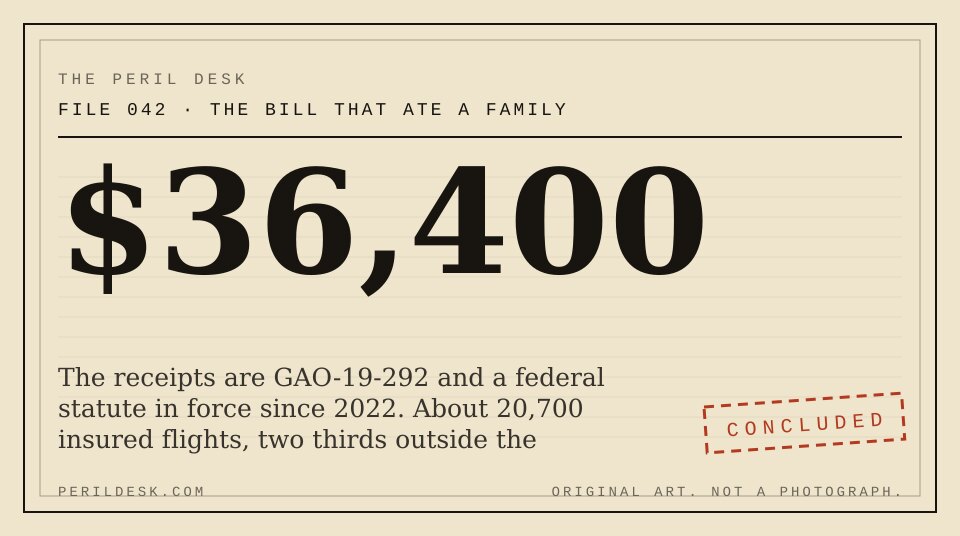
An emergency helicopter lands, a patient is loaded, and the aircraft is gone in minutes. The bill arrives weeks later, and in 2017 the median one for a helicopter was about $36,400.
That figure is the Government Accountability Office’s. In March 2019 it published GAO-19-292, a review of what air ambulance companies charged privately insured patients and how often the flight fell outside the patient’s network.
The answer to the second question was 69 percent.
The federal numbers
GAO worked from the most complete private-insurance data it could find, a FAIR Health data set covering about 20,700 air ambulance transports of privately insured patients in 2017 with network status recorded.
Of those transports, 69 percent were out of network.
Not a minority of flights. More than two thirds. GAO put the comparable figure for ground ambulances at 51 percent in 2014, citing one study, and noted the air figure was higher than for other emergency services as well.
GAO also reported the prices. The median price charged was about $36,400 for a helicopter transport and $40,600 for a fixed-wing transport in 2017. Five years earlier, in 2012, the medians had been about $22,100 and $24,900. GAO called that an increase of over 60 percent.
GAO wrote its own caveat into the report. The FAIR Health data “may not be representative of all private insurers and therefore cannot be generalized,” and the data “do not indicate the extent to which patients received balance bills and, if so, the size of the bills.”
The word for what happens next
A balance bill is the unpaid difference charged straight to the patient.
It happens when a medical provider is out of network, which means the provider has no price agreement with the health plan. With a contract in place, the provider accepts the negotiated rate and the argument is over. With no contract, the provider can bill its own price, collect whatever the insurer sends, and pursue the household for the gap.
For a scheduled procedure, network status is something a patient can check in advance.
For an emergency helicopter, there is nothing to check. Nobody in a hospital corridor is handed a choice of operators. The aircraft that is available is the aircraft that comes.
What the complaints looked like
GAO found no national data on balance bills, so it read the complaints two states had collected. Maryland and North Dakota were the only states in its review able to say how large individual balance bills were.
Of more than 60 complaints, all but one was for a balance bill over $10,000. Maryland’s roughly two dozen ran from $12,300 to $52,000. North Dakota’s three dozen ran from $600 to $66,600.
One reported case
The Arizona Republic reported one such bill on June 26, 2018. By its account, a four-year-old named Ezra Brunner could not breathe properly on Christmas Day, a ground ambulance took him to Verde Valley Medical Center, staff diagnosed croup, and doctors recommended a flight to Flagstaff. Air Methods flew him. The Republic reported the flight took about fifteen minutes and was billed at $47,000, that the family’s insurer agreed to pay $5,000, and that the company billed the family for the remaining $42,000.
The Republic also reported that within days of the newspaper contacting the companies, and after Ezra’s father posted publicly about the bill, the air ambulance company and the insurer offered to reduce it. The bill moved because a newspaper called and a parent went public. It did not move because a rule required it to.
The patient was four years old. The decision to fly was made by doctors. The operator was whoever was dispatched. Every point at which a consumer could have influenced the price had already passed by the time the aircraft lifted off.
The rule that arrived later
The practice did change, by statute rather than by negotiation.
Section 300gg-112 of Title 42, headed “Ending surprise air ambulance bills,” was added by the Consolidated Appropriations Act, 2021, signed on December 27, 2020, and applies to plan years beginning on or after January 1, 2022. For an out-of-network air ambulance, “the cost-sharing requirement with respect to such services shall be the same requirement that would apply if such services were provided by such a participating provider,” and those amounts count toward the in-network deductible and out-of-pocket maximum.
Ground ambulances were left out. As KFF put it in June 2021, “the protections do not apply to ground ambulance services, and the law instead requires a federal advisory committee to study the issue.”
The 2017 flights GAO counted happened five years before that protection existed. GAO’s own sentence on the risk is the plainest in the report: “69 percent of about 20,700 transports in the data set were out-of-network in 2017.”