Two American cities burned thirteen months apart.
Chicago went first, on October 8 through 10, 1871. Boston’s mercantile district followed on November 9 and 10, 1872.
Between them, by the reference counts, they bankrupted somewhere between ninety and one hundred insurance companies.
Not that many claims denied. That many companies that stopped existing.
Chicago, October 1871
About 200 fire insurance companies were doing business in Chicago when the fire started, by the count in the EH.net economic history encyclopedia. The Encyclopedia of Chicago counts 129 insurance companies of all kinds in the city in 1871, 81 of them fire and marine insurers.
Insurance losses from the fire came to between $90 million and $100 million in 1871 dollars. Using the federal consumer price index, $100 in 1871 is equivalent to about $2,737 in 2026, which puts the Chicago insured loss at roughly $2.5 billion to $2.7 billion in 2026 money.
At least half of the property in the burnt district was insured. On paper, that was a city with real protection.
Then the paper met the balance sheets.
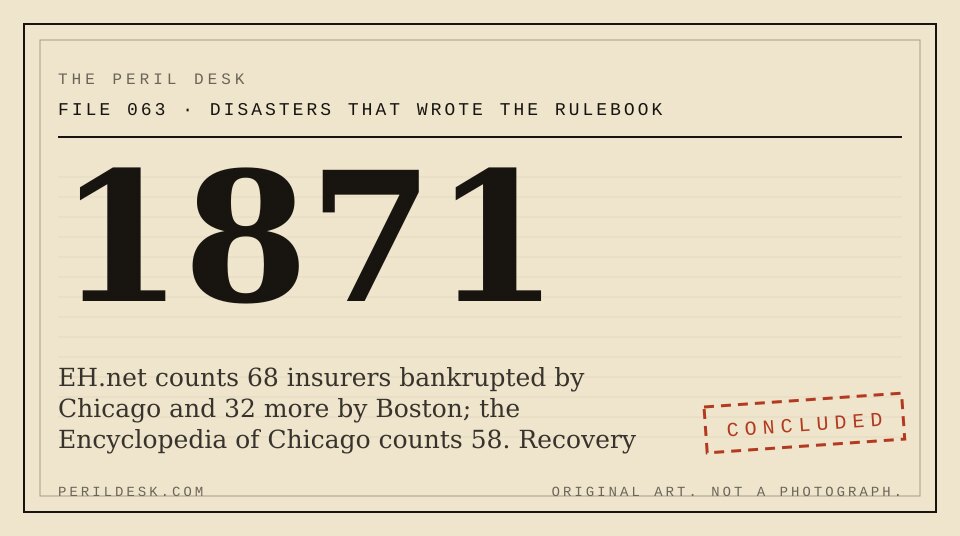
EH.net counts 68 companies bankrupted by the fire. The Encyclopedia of Chicago counts 58. Either way, Chicago policyholders recovered only about 40 percent of what they were owed.
Sixty cents on every dollar of legitimate, paid-for coverage simply did not arrive, because the companies that owed it no longer had anything to pay with.
The Encyclopedia of Chicago puts it another way: the industry paid the claims of only about half of the Chicagoans who held policies, and by the most generous estimate covered less than a third of the total fire damage.
Why a fire could kill a company outright
A fire insurer collects premiums against the ordinary rate of ordinary fires, and holds reserves sized for that ordinary rate.
A company with a book concentrated in one commercial district was therefore not running two hundred separate bets. It was running one, and it did not know that until the district burned.
Chicago was that district for at least 58 of them.
Boston, November 1872
Thirteen months later the same kind of test was run again, on a different city, against a field that Chicago had already thinned.
The Great Boston Fire destroyed the city’s mercantile district over two days in November 1872. Insured losses totaled more than $50 million in 1872 dollars. On the same federal index, $100 in 1872 is equivalent to about $2,737 in 2026, which puts the Boston insured loss above $1.36 billion in 2026 money.
Insurance penetration was even higher than in Chicago. About 75 percent of the ruined buildings and their contents were insured.
The fire bankrupted an additional 32 companies, by the EH.net count.
That is the number that gives this pair its shape. Chicago had already removed dozens of companies from the American market. Boston removed thirty two more from what was left.
The two recovery numbers
Chicago policyholders recovered about 40 percent of what they were owed.
Boston policyholders, thirteen months later, recovered about 70 percent.
Same country, same era, two dense downtowns burned thirteen months apart. Nearly double the recovery rate.
EH.net gives one reason for the gap, and it is about what burned. Boston’s fire fell on commercial property, which the encyclopedia says was everywhere more likely to be insured, and about 75 percent of the ruined buildings and their contents were covered.
By this desk’s reading, the companies paying Boston’s claims in November 1872 were companies that had not failed in October 1871, and by the two reference counts, Chicago had already removed 58 to 68 companies from the field.
Whatever else changed between the two fires, the roster of insurers had been cut by the first before the second was run.
The companies that paid
The failures are the loud half of the story. The other half is that a great many claims were paid, in full, by companies that could have gone under and chose to stay in.
The pattern had a precedent. After the 1835 fire in New York, by the New England Historical Society’s account, 23 of that city’s 26 insurance companies declared bankruptcy, while the Hartford Fire Insurance Company honored its claims and took the market that the failures left behind.
For 1871, The Hartford’s own published history says only this: “After fire ripped through more than three square miles of Chicago streets, businesses, and homes, we stood by the city.” That is the company’s account of itself, and it prints no dollar figure.
Paying a catastrophe is not charity and it is not marketing. It is the only demonstration that an insurance promise means anything, and it can only be demonstrated at the worst possible moment.
What the ledger looked like when it settled
Add the two fires together.
Ninety to one hundred companies bankrupted in thirteen months, depending on the count. In Chicago, roughly 60 cents of every insured dollar unpaid. In Boston, roughly 30 cents unpaid.
Every one of those unpaid dollars belonged to somebody who had bought coverage and had done nothing wrong.
A failed insurer in 1871 or 1872 was not like a failed insurer today. There was no guaranty association, meaning no state backstop fund financed by other carriers to pick up the claims of a company that goes under. The Wisconsin Insurance Security Fund, created by that state’s legislature in 1969, describes itself as the nation’s first comprehensive guaranty association. That was ninety eight years after Chicago burned.
When a company failed in 1871, the policyholder’s claim failed with it. That is the entire difference between the nineteenth century ledger and the modern one, and it was built out of exactly this kind of year.
Why the pair beats either fire alone
The Chicago fire on its own is a famous disaster story, and it gets told as scale. A city gone.
Told that way it teaches nothing, because every catastrophe is large.
The pair teaches something the single fire cannot. Two tests, run thirteen months apart on two dense American downtowns, produced recovery rates of 40 percent and 70 percent.
Solvency is not an accounting detail sitting behind the product. In 1871 and 1872 it was the product, and somewhere between ninety and a hundred American companies proved it by not having any.
The reference records of both fires, including the failure counts and the recovery percentages, are linked in Sources below.