Line item. Thirty-nine dollars and thirty-five cents. Description: skin to skin after c-sec.
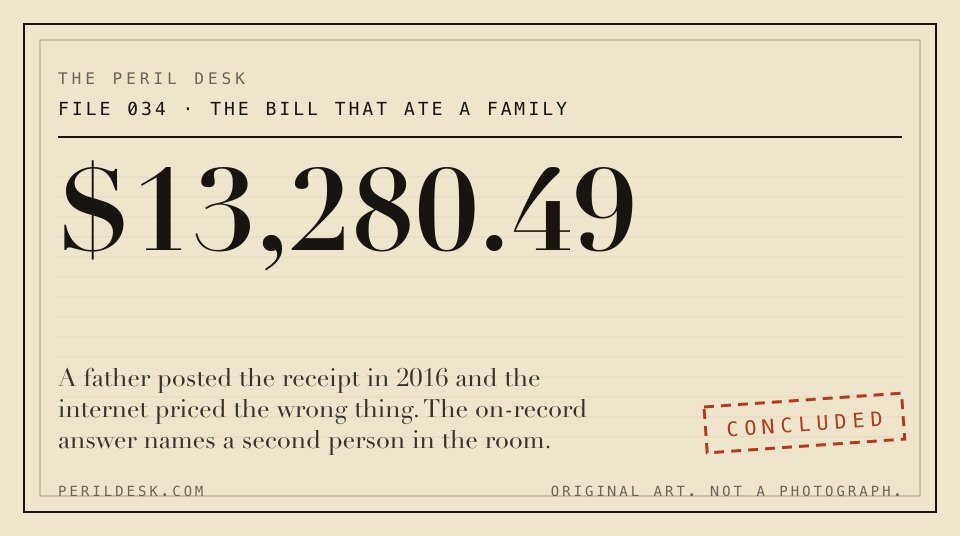
That is a real row on a real hospital bill, one line on an itemized statement that totaled $13,280.49.
Translated out of billing language, it appeared to say that a hospital had put a price on a father holding his newborn son.
The family and the receipt
Ryan Grassley and his wife Lidia had a son, Samuel, born by cesarean section on September 4, 2016, at Utah Valley Hospital in Provo, Utah.
Grassley posted a photograph of the itemized bill online. By October 5, 2016 it had been covered by NPR, CBS News, ABC News and TODAY.
The reason it traveled is not complicated. Skin-to-skin contact, laying a naked newborn on a parent’s bare chest in the first minutes of life, is a practice the World Health Organization recommends, and a Cochrane review published in October 2025 called it the standard of care.
And here it was, itemized, priced, and totaled.
The line did not appear alone. It sat inside a full itemized statement of a surgical delivery, the kind of document that runs to dozens of rows covering the operating room, the anesthesia, the pharmacy, the nursery and the stay.
Almost every one of those rows is opaque to anyone outside hospital billing. They are procedure codes and department abbreviations.
This one row was not opaque. Anybody could read it, which is the only reason anybody did.
Why an itemized bill lands harder than a total
A hospital bill for a birth runs into thousands of dollars, and almost nobody reacts to the total. It is too large and too abstract to feel like anything.
Thirty-nine dollars and thirty-five cents is different. It is small enough to picture and specific enough to argue with.
The un-round cents are what finish it. A flat forty dollars would read as an estimate. The thirty-five cents reads as a machine that measured something.
That is the strange power of itemization. Breaking a bill into its parts is the thing that makes it possible to audit, and the same act is what makes it look absurd.
Underneath every line is a chargemaster, the internal price list a hospital maintains for each billable item and service. Nothing reaches a bill without a chargemaster row behind it.
Which means every human moment that consumes a resource has to be assigned a description short enough to fit in a column. The description is written by billing staff for insurers and auditors, not for the family who will eventually read it.
Nobody in that chain is choosing words for how they will sound to a new father.
The number changed in transit
Something happened to the figure while it traveled, and it is the reason this file exists at all.
A second version began circulating in which the charge was $39.95, not $39.35. It moved far enough that a fact-checker wrote it up under the wrong number.
Sixty cents is a trivial gap. What it demonstrates is not trivial. A receipt that had been photographed, published in full, and reproduced by national outlets still got copied wrong.
That is what happens to documents when they become entertainment. They get retyped from memory, and each retyping is a small opportunity for the story to drift toward whatever version is most satisfying.
A photograph of a receipt is about as solid as evidence gets. It still lost sixty cents in transit.
The wrong figure spread far enough that a fact-checking site indexed the story under it, which is how a corrected version ends up permanently attached to the false number. Anyone searching the amount they remember finds the debunk of a bill that was never issued.
And the drift was not confined to the number. The same thing was already happening to what the line meant.
The answer is not the one the internet wrote
Then the hospital responded, and its explanation pointed at something the coverage had not priced.
The charge was not for the holding.
Utah Valley Hospital’s position, reported by ABC News at the time, was direct: “There is never a charge for a patient to hold their baby.” And then: “There is an additional charge associated with bringing an extra caregiver into the OR.”
What the line covered was staffing. In a cesarean, the mother is in surgery, sterile field and all, with a surgical team working on her.
For skin-to-skin contact to happen safely in that room, an additional nurse has to be brought in whose only job is to watch the newborn while the operation continues.
That extra nurse is a person, on a shift, being paid. The $39.35 was the hospital charging for the second caregiver it added so that the moment could happen at all.
The charge was not the price of affection. It was the price of the staffing that made affection possible in an operating theater.
The second thing everyone got wrong
The other assumption baked into the coverage was that the father was furious.
He was not.
Grassley said he had no plans to contest the bill. “I just thought that was funny,” he told ABC News.
He also wrote that “the hospital and staff were great throughout the entire process.”
So a hospital bill that ran on four national outlets carried an explanation on the record, a charge with a stated reason behind it, and a father who was not complaining about any of it. Every ingredient of the outrage came from the document alone.
A staffing note read as a charge for a hug
None of that makes the story pointless. It makes it a better story, and a more useful one.
What the bill exposed was a translation failure. Hospitals bill in units of resource consumption, because that is what a chargemaster is built to record. Families read bills in units of human experience.
An extra nurse assigned to watch a newborn during surgery, and “skin to skin after c-sec,” describe the same $39.35. One of them is a staffing note. The other reads as a hospital charging for a hug.
The billing system chose the second wording, and the second wording went around the country.
The rows on the same photograph nobody quoted
The $39.35 was one row on a bill that totaled $13,280.49. The rows carrying the other $13,241.14 were on the same photograph, in plain view, and they were not the story.
A charge that is easy to picture gets a national news cycle. A charge that is large, coded, and impossible to picture gets paid.
That asymmetry is the actual subject, and it survived 2016 completely intact.
Where the file sits
This entry is logged in The Bill That Ate a Family with the primary artifact, the posted itemized bill, and the hospital’s on-record explanation held alongside it. Both readings stay in the file, because both are documented, and the correction is the point.